
Making Tax Digital
for landlords.
UK Self Assessment landlords · April 2027 (£30k) & April 2028 (£20k) threshold checker
Did your combined gross property and sole-trader income exceed £30,000 before expenses in the 2025/26 tax year? If so, Making Tax Digital (MTD) for Income Tax applies to you from 6 April 2027 (and from 6 April 2028 if over £20,000 in 2026/27). Use the calculator below to check your personal share of joint rental income and see which easements apply.
Calculate your MTD start date ↓Check your qualifying income
and joint-property share.
HMRC counts your personal share of gross rental income (before deducting repairs, letting agent fees or mortgage interest) plus any sole-trader turnover. PAYE employment salary, pensions, dividends and limited company rents do not count towards the MTD threshold.
The three rollout phases
and joint-owner rules.
HMRC checks the Self Assessment tax return you file for the qualifying year below to determine when you must start sending quarterly updates.
| Qualifying gross income | Assessed on tax return for | Mandatory MTD start date | How joint or company ownership works |
|---|---|---|---|
| Over £50,000 | 2024–25 (filed by 31 Jan 2026) | 6 April 2026 (live now) | A sole owner taking £52,000 gross rent is already in Phase 1. Two 50/50 joint owners of the same portfolio each have £26,000 qualifying income, so neither entered in April 2026. |
| Over £30,000 | 2025–26 (filed by 31 Jan 2027) | 6 April 2027 | Covers sole landlords over £30,000 gross, or a 50/50 joint owner where total portfolio rent exceeds £60,000 (or where their share plus self-employed turnover exceeds £30,000). |
| Over £20,000 | 2026–27 (filed by 31 Jan 2028) | 6 April 2028 | Brings most single-property landlords in London and the South East (rent above £1,667/month) and 50/50 joint owners of £40,000+ portfolios into MTD. |
| Limited company (SPV) | Corporation Tax (CT600) | Not covered by MTD for ITSA | Properties held inside a limited company pay Corporation Tax and are outside Making Tax Digital for Income Tax (though director personal rental property still counts). |
Some landlords qualify for digital exclusion or other exemptions. Check the official HMRC exemptions on GOV.UK.
Quarterly update deadlines
and what you send.
Under MTD, you keep digital records of rental income and expenses and send four cumulative quarterly summaries to HMRC each year, followed by your final tax return by 31 January. Tax payment dates do not change.
| Quarter | Standard tax-year period | Calendar-quarter election option | Submission deadline |
|---|---|---|---|
| Quarter 1 | 6 April to 5 July | 1 April to 30 June | 7 August |
| Quarter 2 | 6 April to 5 October (cumulative) | 1 April to 30 September (cumulative) | 7 November |
| Quarter 3 | 6 April to 5 January (cumulative) | 1 April to 31 December (cumulative) | 7 February |
| Quarter 4 | 6 April to 5 April (full year cumulative) | 1 April to 31 March (full year cumulative) | 7 May |
Because quarterly updates are cumulative from the start of the tax year, if you find a forgotten repair receipt from May in October, you simply include it before sending Quarter 2—no separate amendment is needed for Quarter 1.
Two HMRC easements every
small landlord should know.
HMRC allows simplified reporting for landlords under the £90,000 VAT threshold and for jointly owned rental properties.
1. The under-£90,000 three-line rule
If your gross property income is below £90,000 a year, you do not have to split every repair, insurance premium and management fee into separate SA105 boxes every quarter.
You can record each transaction simply as total rental income, total allowable running expenses, and—for residential lets—residential finance costs (mortgage interest), which must stay separate for the 20% Section 24 tax credit.
2. The joint-property quarterly easement
If you own property jointly (for example, 50/50 with a spouse or sibling) and reconcile shared bills at the end of the year, HMRC lets you report only your share of gross rental income in the four quarterly updates and enter your share of joint expenses once at the end of the year before submitting your return.
Can I still use a spreadsheet for Making Tax Digital?
Yes, provided you use HMRC-recognised "bridging software" that links dynamically to your spreadsheet cells and transmits the quarterly totals digitally to HMRC without manual copy-and-pasting.
What happens if my letting agent deducts fees before paying me?
Your qualifying income is the gross rent paid by the tenant before your letting agent deducts their commission or repair bills. Keep your monthly agent statements so you record the full gross rent as income and the agent's fee as an allowable expense.
What if my qualifying income is £20,000 or below?
HMRC has not announced an MTD start date for landlords whose combined gross property and sole-trader income stays at £20,000 or below. You continue filing your normal annual Self Assessment return.
Check the official HMRC guidance
- GOV.UK — Check if you’re eligible for Making Tax Digital for Income Tax
- GOV.UK — Work out your qualifying income for MTD
- GOV.UK — Create digital records for MTD (including under-£90k and joint property rules)
- GOV.UK — Send quarterly updates
- GOV.UK — Find software that is compatible with Making Tax Digital for Income Tax
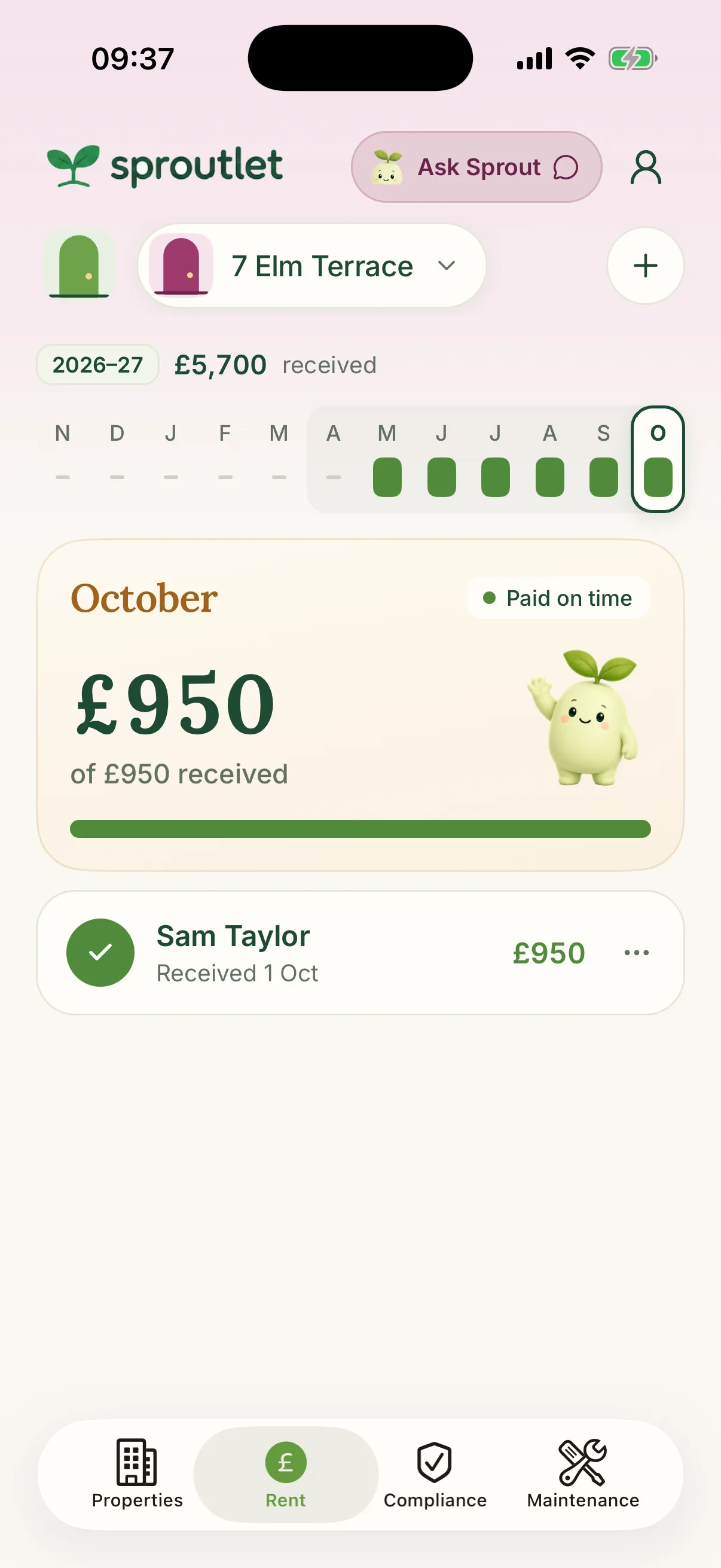
Keep a clear record of the rent.
Record rent payments against the right property and month, so you can find them when you need them.

 Founding landlordSproutlet interest listFirst year freeLaunch updates
50founding places
No.01of 50 · next place available
No.is yours. Your first year is free at launch.
Keep in touch.Join for development and launch updates.
Your free year starts at launch.
Email hello@sprout-let.co.uk to join the list.
Want to talk about the app? Say hello.
Know a landlord who would like to join? Share the founding offer
Places follow signup order from 29 September 2026, one per email address.