SproutletGet your ticketJoin the list

Landlord register:
find your dates.

Landlord registration · England, Scotland, Wales and Northern Ireland

England's Register your rental property service opens on 15 December 2026, starting with the West Midlands. It is the first stage of the Private Rented Sector (PRS) Database under the Renters' Rights Act 2025. Each English region has a three-month mandatory window, finishing on 14 November 2027. The government registration fee is £65 per property a year. Enter your rental postcode below to check your dates, or see the existing schemes in Scotland, Wales and Northern Ireland.

By Lewis Danks at SproutletChecked 22 November 2026Official sources ↓
01 / Find the property’s area

Where is
your rental?

Select an area on the map, or enter the property's postcode.

Nine English rollout regions, plus Scotland, Wales and Northern Ireland with existing schemes. Select an area or use the labelled region menu.
England: regional rollout (from 15 Dec 2026)Scotland, Wales & NI: existing schemes

Find your registration dates.

Postcodes are looked up by Postcodes.io and are not saved by Sproutlet.

Use the rental property's location.
It may be different from your home address.

02 / Check the schedule

England's registration
schedule.

Landlords covered by the rollout can register eligible properties from 15 December 2026. You can register early once the service opens, or during your region's three-month window. Select a region below for its exact dates.

Updated for the October 2026 official GOV.UK service guidance. Check the GOV.UK landlord service guide and letting agent guide for the latest rules before registering.

Scroll or swipe for all nine English regions.

What the PRS database covers

The Register your rental property service is the first operational stage of England's Private Rented Sector (PRS) Database. It covers assured and regulated private tenancies in England (excluding supported exempt accommodation).

Under the October 2026 GOV.UK guidance, a licensed HMO counts as a single property registration. If a property is jointly owned, every joint landlord must register for their own landlord account, and one owner registers the property and invites the co-owners to link their accounts.

The £65 fee, 28-day window and penalties

  • The annual fee is £65 per property. If you register multiple properties on different dates, fees are prorated so your portfolio aligns to a single annual renewal date.
  • Once you pay the property fee, you have up to 28 days to complete additional safety certificate, tenancy and licensing details (and you must update changes within 28 days).
  • The landlord must initiate registration and pay the fee. A letting agent can then be linked to enter and maintain property and compliance details.
  • Failing to register once required can mean a civil penalty of up to £7,000 (or up to £40,000 for false information or repeated breaches), and courts generally cannot grant possession while entries are missing or inactive.
Read the official GOV.UK landlord guidance ↗

03 / Check what you have

What do you
need to prepare?

Work through the eight registration requirements below, or select your region above to generate a custom printable action list. Your answers stay in your browser and are never saved.

Choose your property’s region or UK nation above to answer the interactive readiness check for your area, or review the 8 England preparation checks in the table below.

Check 01

Have you checked whether the service covers your tenancy?

The published scope includes assured and regulated tenancies, with exclusions. Empty properties have different rollout arrangements.

Next step: Check the covered tenancy types before relying on the rollout dates.

Check 02

Can you sign in with GOV.UK One Login?

You will need GOV.UK One Login to use the registration service.

Next step: Check your sign-in works. If you need an account, create one when you first use a service that requires it.

Check 03

Have you gathered the landlord and ownership details?

Include joint owners, organisation details and any authority to act. Keep these details in your own records; do not enter them here.

Next step: Collect the relevant owner contacts, organisation details and any authority to act.

Check 04

Are the property, tenancy and rent details ready?

You need details such as the address, property type, bedrooms, occupants, households, furnishing, rent and payment frequency.

Next step: Gather the address, property type, bedrooms, occupants, households, furnishing, rent and payment frequency.

Check 05

Do you have the gas safety record and issue date?

This applies where the property has a gas supply. Check your circumstances before choosing "Not applicable".

Next step: Locate the latest record. If a check is due, book a Gas Safe registered engineer qualified for that work.

Check 06

Do you have the electrical report or certificate?

Locate the Electrical Installation Condition Report (EICR), or the appropriate Electrical Installation Certificate (EIC). Check its dates.

Next step: Check the report for outstanding work and the next inspection date. Arrange an inspection by a qualified person if needed.

Check 07

Have you reviewed the EPC and any exemption?

Check the current tenancy's energy performance certificate (EPC) and whether an energy-efficiency exemption applies.

Next step: Find the EPC or arrange an assessor for a new one. Check exemption requirements if they apply.

Check 08

Have you checked which council licences you need?

HMO, additional and selective licensing are separate from the new registration service.

Next step: Find the council's rented-property licensing guidance. Check what applies and keep the relevant licence details.

For properties in England

Find the records
you need.

For a property outside England, choose its UK nation to check the existing registration scheme.

Need to check your certificate rules first? Read our guides to the landlord gas safety certificate (CP12) & EICR and EPC rules for landlords.

Check the
original guidance.

Confirm what applies to your rental with the official scheme.

How the map and postcode lookup work

The map shows English regions and UK nations, rather than property boundaries. Postcodes.io uses postcode geography to identify an area. If a postcode crosses a boundary, confirm the property's location with the official scheme. Crown Dependencies are outside this guide. You can use the map and area menu without sending a postcode.

Source: Office for National Statistics licensed under the Open Government Licence v.3.0. Contains OS data © Crown copyright and database right 2025. Map licensing. Postcode data and limitations. How this tool handles your information.

Know where the property records are.

Find the tenancy details, safety records and repair files with the rental they belong to.

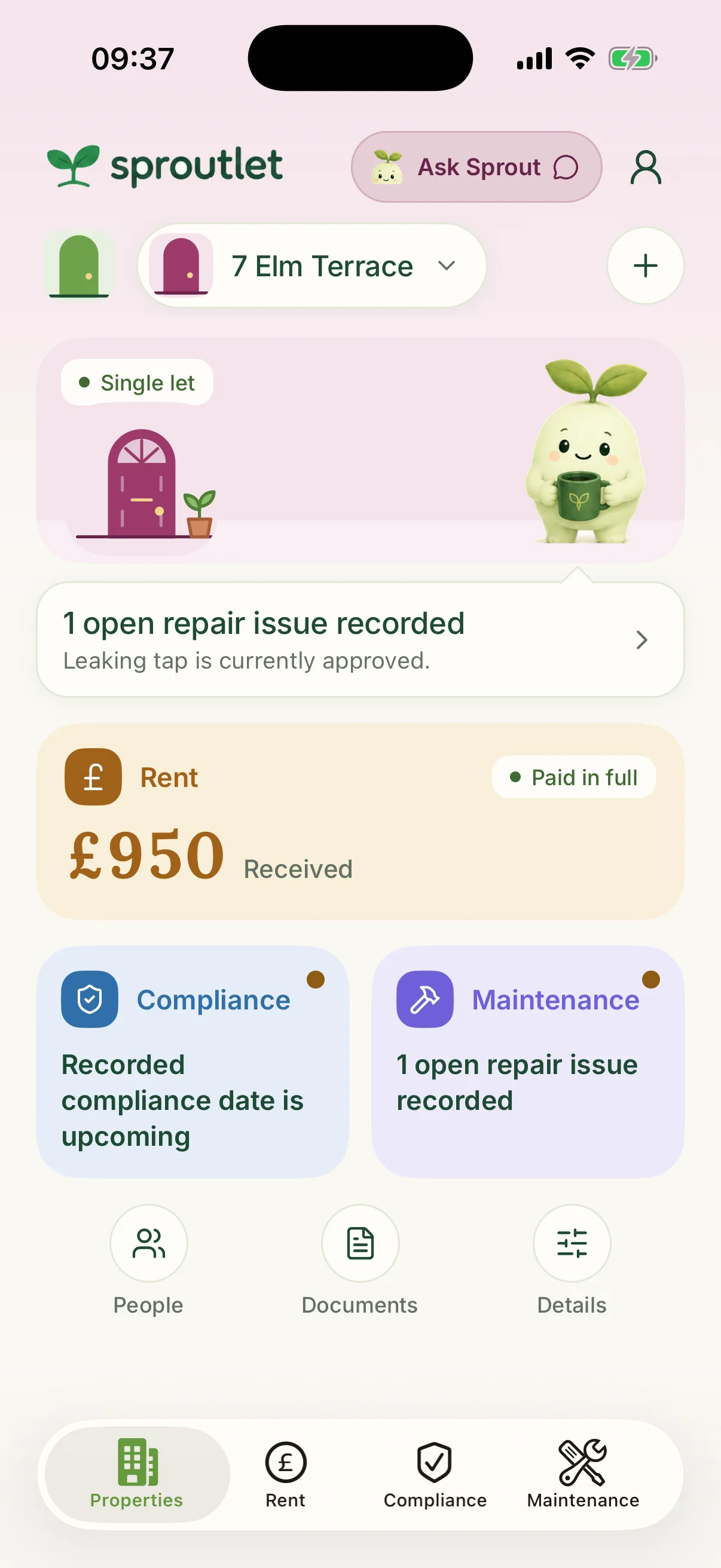
Sproutlet’s Properties screen, with rent, compliance and maintenance for the selected rental.
Explore the app
Sproutlet with a mug, offering a little help.
Founding landlordSproutlet interest listFirst year freeLaunch updates

50founding places

No.01of 50 · next place available

No.is yours. Your first year is free at launch.

Keep in touch.Join for development and launch updates.

Your free year starts at launch.

Places follow signup order from 29 September 2026, one per email address.