
Section 8 & Form 3A
possession grounds.
England · Post-1 May 2026 rules · Form 3A notice periods & Ground 1 / 1A / 8 checker
On 1 May 2026, Section 21 "no-fault" eviction notices were abolished in England under the Renters' Rights Act 2025. To end an assured periodic tenancy—whether you need to sell the property, move in yourself, or deal with serious rent arrears—you must serve official Form 3A citing one or more statutory possession grounds from Schedule 2 to the Housing Act 1988. Use the interactive ground and notice-period checker below.
Check Form 3A notice dates ↓Form 3A possession ground
and notice-period finder.
Select your possession ground, the date the tenancy originally began, and the date you plan to serve Form 3A to check the minimum notice expiry date and 12-month protected-period rules.
Key possession grounds
in England from 1 May 2026.
For a mandatory ground, the court must grant a possession order if you prove the ground and valid service. For a discretionary ground, the judge also decides whether it is reasonable to order possession.
| Ground | Type | Form 3A notice period | Key rules & evidence required |
|---|---|---|---|
| Ground 1A · Selling the property | Mandatory | 4 months | Cannot expire during the first 12 months of the tenancy. You must intend to sell the freehold or long leasehold; you are banned from reletting or marketing the property to let for 12 months after serving notice. |
| Ground 1 · Landlord or close family moving in | Mandatory | 4 months | Cannot expire during the first 12 months of the tenancy. The landlord (or spouse, partner, parent, child or sibling) must occupy it as their only or principal home; 12-month no-reletting ban applies. |
| Ground 6 · Major redevelopment or demolition | Mandatory | 4 months | Substantial reconstruction or demolition works that cannot reasonably be carried out with the tenant living in the property. |
| Ground 8 · Serious rent arrears (3+ months) | Mandatory | 4 weeks | At least 3 months’ rent (or 13 weeks for weekly/fortnightly rent) must be unpaid both when Form 3A is served AND at the court hearing (excluding arrears caused solely by delayed Universal Credit processing). |
| Grounds 10 & 11 · Some rent unpaid / persistent late payment | Discretionary | 4 weeks | Normally pleaded alongside Ground 8 on Form 3A so the court can consider possession if the tenant pays arrears down just below 3 months before the hearing. |
| Ground 12 · Breach of tenancy obligation (other than rent) | Discretionary | 2 weeks | Breach of a term of the tenancy agreement (e.g. unlawful subletting). The court decides whether granting possession is reasonable. |
| Ground 14 · Anti-social behaviour or criminal use | Discretionary (7ZA mandatory for serious conviction) | Immediate court application (or 2 weeks for 7ZA) | Notice takes effect immediately for Ground 14, though court proceedings and evidence standards still apply. |
Dealing with missed rent? Read our dedicated rent arrears guide for early communication templates and Ground 8 Universal Credit rules.
Selling (Ground 1A) or moving in (Ground 1):
the two 12-month rules.
The Renters' Rights Act created a dedicated mandatory ground for landlords selling up (Ground 1A) and broadened the family occupation ground (Ground 1), subject to two strict safeguards against misuse.
1. The 12-month initial protected period
When a new tenancy starts, a Form 3A notice relying on Ground 1 (moving in) or Ground 1A (selling) cannot expire within the first 12 months of the tenancy. Because both grounds require 4 months' notice, the earliest you can serve notice on a brand-new tenancy is at the end of Month 8, expiring after Month 12.
2. The 12-month no-reletting ban
If you serve Form 3A using Ground 1 or Ground 1A, you are legally prohibited from marketing the property for rent or letting it to a new tenant for 12 months (calculated from the date notice was served, or from when court proceedings end). Misusing these grounds carries a council civil penalty of up to £40,000 or a Rent Repayment Order.
Check deposit protection and
the PRS Database before serving.
A court can refuse to make a possession order on most grounds if your deposit protection or landlord registration is not in order.
- 1. Tenancy deposit protectionExcept for severe anti-social behaviour grounds (Grounds 7A and 14), a court generally cannot make a possession order unless any tenancy deposit is properly held in an authorized scheme (DPS, MyDeposits or TDS) and the Prescribed Information has been given.
- 2. England’s PRS Database registrationOnce the landlord register rollout deadline applies to your region (starting 15 December 2026 in the West Midlands), courts generally cannot grant a possession order unless both the landlord and the property have active entries on the database.
- 3. Official Form 3A & proof of serviceAlways download the latest Form 3A from GOV.UK, serve every named joint tenant in line with your tenancy agreement's service clause, and take legal advice from a housing solicitor or landlord association before serving.
Check the official guidance
Keep the tenancy, deposit and payment history together.
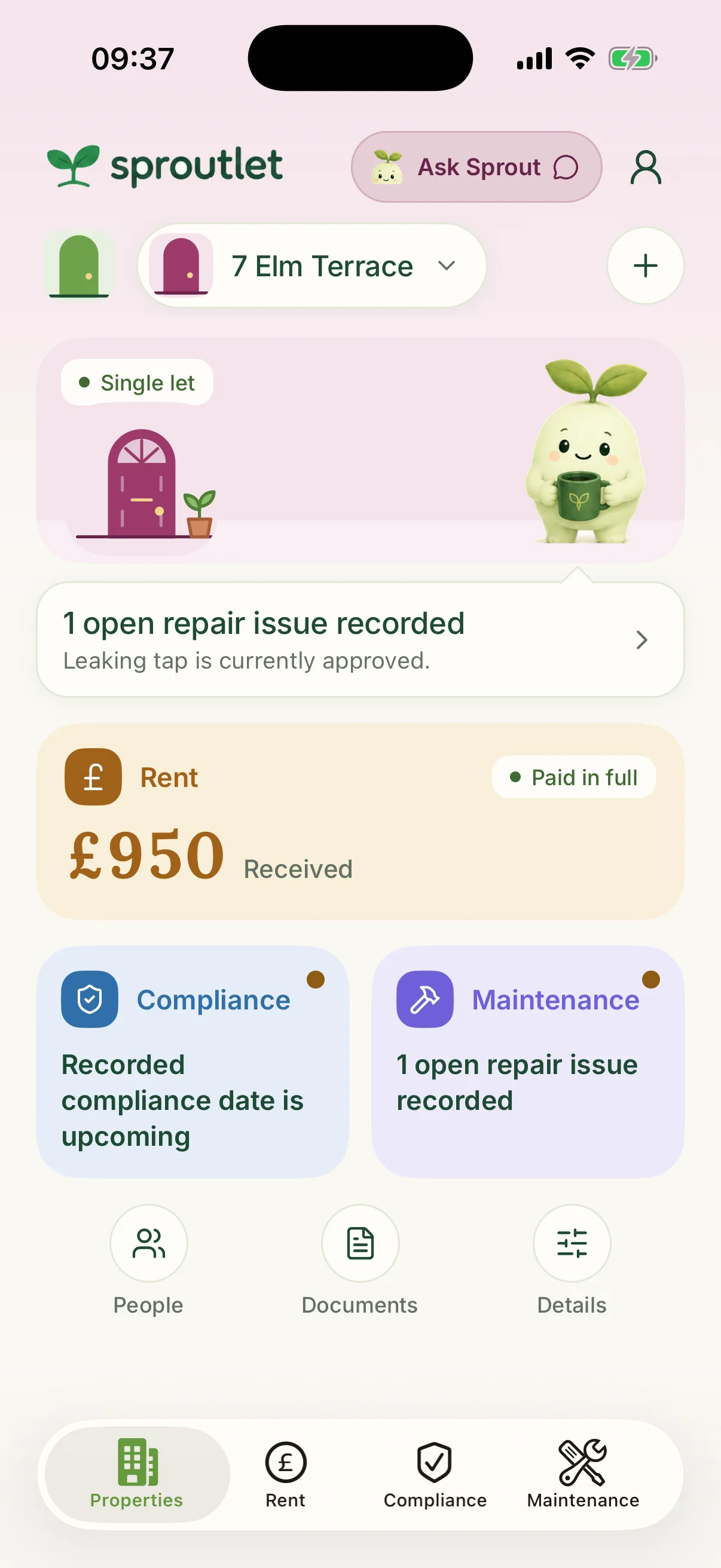
Find the signed agreement, certificate handover dates and rent ledger in one place when you need them.

 Founding landlordSproutlet interest listFirst year freeLaunch updates
50founding places
No.01of 50 · next place available
No.is yours. Your first year is free at launch.
Keep in touch.Join for development and launch updates.
Your free year starts at launch.
Email hello@sprout-let.co.uk to join the list.
Want to talk about the app? Say hello.
Know a landlord who would like to join? Share the founding offer
Places follow signup order from 29 September 2026, one per email address.