
Damp, mould &
Awaab’s Law.
England & UK · HHSRS Hazard 01, Awaab’s Law response timescales & root-cause checklist
Damp and mould growth is Hazard 01 in England's updated 21-hazard HHSRS framework, and the Renters' Rights Act 2025 extends Awaab's Law statutory investigation and repair deadlines to private landlords. GOV.UK guidance is clear: damp and mould must never be dismissed as "tenant lifestyle". Diagnose the root cause promptly, wash down active mould, fix the ventilation or fabric defect, and send your tenant a written summary.
Check response timescales ↓Damp & mould investigation
and response calculator.
Enter the date the tenant reported the issue and its severity to generate your target inspection, written summary and remedial start deadlines modeled on the Awaab's Law framework.
Diagnose the root cause:
four types of damp.
Washing black mould off a wall without fixing the moisture source means the mould will return within weeks. Check these four causes during your inspection.
| Moisture source | Where & how it appears | What to check and fix |
|---|---|---|
| Condensation & poor extraction | Black spot mould on window reveals, cold external wall corners, north-facing bedrooms and bathroom ceilings. | Check bathroom and kitchen extractor fans (upgrade weak axial fans to continuous/humidistat fans), clear trickle vents, check loft and wall insulation, and verify heating can warm every room evenly. |
| Penetrating damp (external fabric) | Localised damp patches on walls or ceilings that worsen after rain; tide marks around chimney breasts, window lintels or gutter runs. | Inspect gutters, hopper heads, downpipes, slipped roof tiles, flashing, porous brickwork/pointing and external window mastic seals. |
| Internal plumbing or heating leaks | Damp patches beneath bathrooms, behind kitchen base units, around radiator valves or along boxed-in pipe ducts. | Check bath/shower silicone sealant, waste traps, washing-machine valves, radiator bleed valves and boiler pressure drops. |
| Rising damp / bridged damp-proof course | Horizontal tide mark up to ~1 metre above ground-floor skirting boards, blistering plaster or white salt deposits. | First check whether external soil, flowerbeds, paving or bridged render sits above the damp-proof course (DPC) level before commissioning a specialist survey. |
Copy-paste written summary
for your tenant after a visit.
A core requirement of Awaab's Law is providing the tenant with a clear written summary after your investigation setting out what caused the damp, what work you are doing, and when it will happen.
Post-inspection written findings template
Subject: Summary of damp & ventilation check — [Property Address]
“Hi [Tenant Name], thank you for letting me inspect the [Room / Area] today ([Inspection Date]) following your report on [Report Date].
What I found: [e.g. There is surface condensation and black mould around the bedroom window reveal, and the bathroom extractor fan is no longer drawing moisture effectively. I checked the external guttering and brickwork above the window and confirmed there is no external rainwater leak.]
What we are doing next:
1. [Contractor Name] is booked for [Date & Time] to replace the bathroom extractor with a continuous humidistat fan.
2. On [Date], we will carry out a fungicidal mould wash and re-coat the window reveal with anti-mould paint.
3. I will check back in with you on [Follow-up Date, ~4 weeks later] to make sure the condensation has stayed clear.
Please let me know if those appointment times work for you, or if you notice any changes in the meantime. Best wishes, [Your Name]”
How Awaab’s Law, HHSRS
and Section 11 fit together.
Three overlapping laws govern damp, mould and repairs in English private rentals.
Awaab’s Law & the Renters’ Rights Act
Originally introduced for social housing in October 2025, Awaab's Law is extended to private rented homes through the Renters' Rights Act 2025. It implies a statutory covenant into tenancy agreements requiring landlords to investigate reported health hazards, provide a written summary of findings, and begin repair works within fixed statutory timescales.
Fitness for Human Habitation & HHSRS
Under the Homes (Fitness for Human Habitation) Act 2018 and HHSRS Hazard 01 (Damp and mould growth), a rental must be free from serious damp and mould from the day the tenancy starts and throughout the let. Councils can serve an Improvement Notice or civil penalty where Category 1 damp or excess cold hazards are left unresolved.
Run a complete pre-winter walkthrough using our rental property inspection checklist, and check insulation and heating upgrade caps in our EPC rules for landlords guide.
Check the official guidance
Keep the damp inspection, photos and repair together.
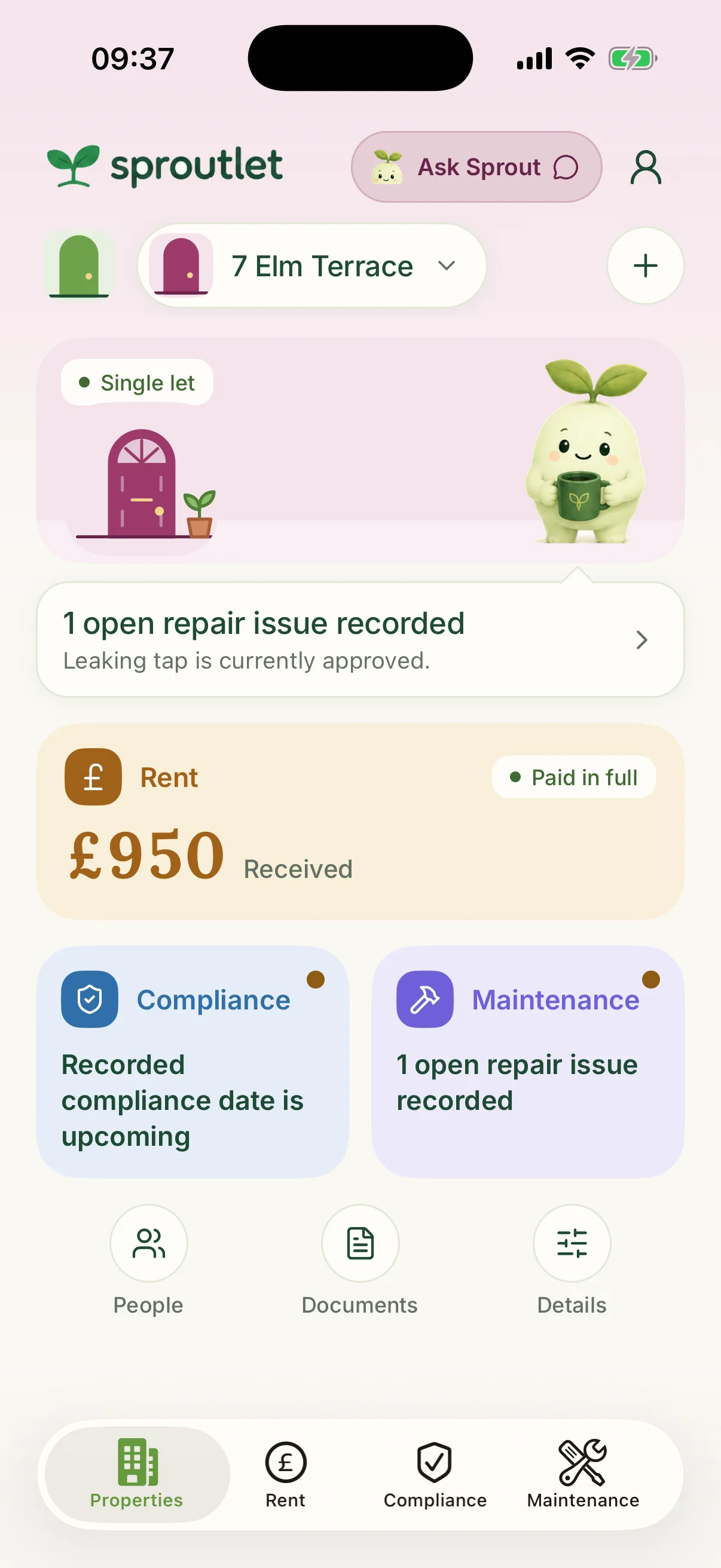
Track the repair from the tenant's first message through extractor fan quotes, photos and completion.

 Founding landlordSproutlet interest listFirst year freeLaunch updates
50founding places
No.01of 50 · next place available
No.is yours. Your first year is free at launch.
Keep in touch.Join for development and launch updates.
Your free year starts at launch.
Email hello@sprout-let.co.uk to join the list.
Want to talk about the app? Say hello.
Know a landlord who would like to join? Share the founding offer
Places follow signup order from 29 September 2026, one per email address.